A misstep off a curb, a landing during a game, or a twist at work can leave an ankle painful and swollen within minutes. It is tempting to call every twist a sprain, but a fracture and a ligament injury can feel surprisingly similar at first. Both can cause pain, bruising, swelling, and trouble walking. The safest next step is an exam when the symptoms suggest a broken bone or a more significant injury.
An ankle injury does not need to look dramatic to deserve attention. A clinician can combine the story of the injury, an examination, and an X-ray when appropriate to sort out a fracture, a sprain, or another injury around the ankle and foot.
Why a twist can injure more than one structure
The ankle is where the tibia and fibula of the lower leg meet the talus in the foot. Ligaments hold those bones in position. When the foot rolls inward or outward, a ligament can stretch or tear; that is an ankle sprain. The same force can break the outer ankle bone (fibula), inner ankle bone (tibia), talus, or a nearby bone in the foot.
Pain on the outside of the ankle is common with a sprain, but location alone cannot confirm the diagnosis. A high ankle sprain can hurt above the ankle joint, while a fracture may cause pain at one specific bony spot. An inversion twist can also injure the base of the fifth metatarsal on the outside of the foot. That is why an evaluation should include the ankle and foot rather than only the most swollen area.
For more background on the structures involved, see our foot and ankle guide. Do not try to test whether the ankle is “loose” by forcefully rolling it again. That can add pain and may worsen an injury.
Signs that deserve a same-day evaluation
It is reasonable to arrange a prompt evaluation after a twist if you cannot take four steps, even with a limp, either right after the injury or now. Other reasons to be checked include tenderness directly over the bony points on either side of the ankle, pain over the top or outside of the midfoot, marked swelling or bruising, or pain that keeps you from using the foot normally.
Clinicians may use the Ottawa Ankle Rules as one part of the decision about X-rays. These rules consider weight bearing and specific bony tenderness; they are not a home test and they do not replace an examination. Young children, people with reduced sensation in their feet, and people with certain medical conditions may need an individualized assessment.
Even if you can walk, seek care if pain is getting worse, the ankle feels unstable, or symptoms are not improving as expected. Some fractures and tendon or cartilage injuries are not obvious from the first few steps. An X-ray evaluation can help identify a fracture or alignment problem. A normal X-ray does not rule out every soft-tissue injury, so the examination and follow-up plan still matter.
When an emergency department is the better choice
Go to an emergency department right away for an ankle or foot that is visibly deformed, has a bone protruding through the skin, is cold or pale, or has new numbness or weakness. Seek emergency care for uncontrolled bleeding, a serious wound, or an injury involving major trauma. Do not try to straighten a deformed ankle or push a protruding bone back into place.
If the foot is in a normal position but you have severe pain, substantial swelling, or cannot bear weight after a twist, same-day orthopedic urgent care can assess the injury and determine whether imaging, a splint, a boot, crutches, or emergency transfer is appropriate. If you are unsure where to go, choose the setting that can evaluate the severity safely rather than driving on a painful ankle.
What to do while you arrange care
Protect the ankle from another twist. Stop the activity, avoid forcing weight through the foot, and use crutches or another aid if you already have one and can use it safely. Elevating the leg can help limit swelling. A cold pack wrapped in a towel for short intervals may provide comfort; do not place ice directly on the skin. A light elastic wrap can be useful for some people, but it should not cause tingling, numbness, increasing pain, or a change in toe color.
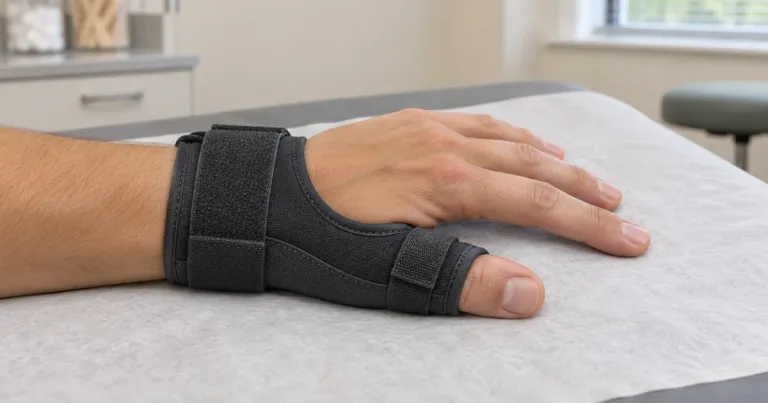
Avoid sports, ladders, uneven trails, and driving if you cannot safely control the pedals. Do not assume a brace makes a fracture safe to walk on. A clinician can give specific guidance after identifying the injury. Learn more about how splinting and casting may be used to protect an injury.
If you use an over-the-counter pain reliever, follow the product label and ask a clinician or pharmacist first if you have kidney disease, liver disease, a stomach ulcer, take blood thinners, are pregnant, or have been told to avoid that medicine. Pain medicine can make an injury more manageable, but it should not be used to push through a possible fracture.
What happens at an ankle injury visit
At an evaluation, share how the foot moved, whether you heard or felt a pop, when you last walked normally, and where the pain is most focused. The clinician checks circulation, sensation, skin, bony tenderness, movement, and the stability of the ankle as appropriate. X-rays can show many fractures and changes in joint alignment. Depending on the findings, treatment may include protection in a brace, splint, cast, or boot; activity changes; follow-up imaging; or referral for a fracture that needs more specialized treatment.
Recovery depends on the exact diagnosis. A mild sprain, a stable fracture, and a more complex fracture do not have the same plan or timeline. Returning to work, surfing, running, or court sports too early can lead to another injury. Ask when it is safe to bear weight, start motion, and return to the activities that matter to you.
If a twist left you with ankle pain, bony tenderness, or trouble taking four steps, request an appointment with Wiki Wiki Orthopedics on Oʻahu or call (808) 439-6201 for guidance on an evaluation.
Sources
- Acute Trauma to the Ankle, American College of Radiology Appropriateness Criteria
- Ankle Injuries and Disorders, MedlinePlus, U.S. National Library of Medicine
- Sprained Ankle, American Academy of Orthopaedic Surgeons