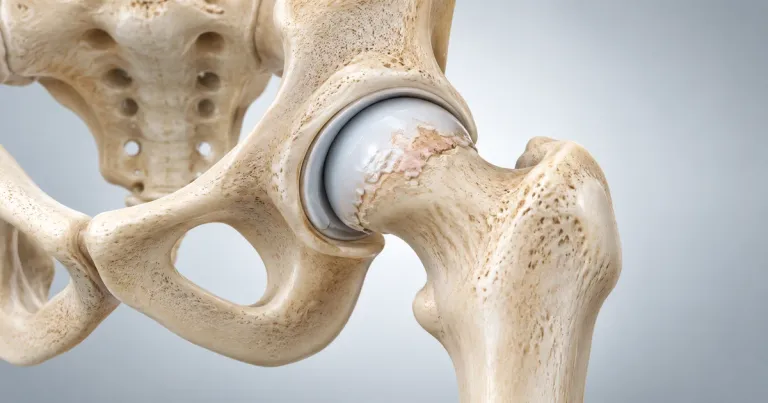
Hip pain can make walking, climbing stairs, getting into a car, or sleeping comfortably surprisingly difficult. Many people assume a painful hip must be a pulled muscle. Others worry that any hip pain means they need a replacement. Neither assumption is reliable. Arthritis, tendon irritation, a muscle strain, bursitis, referred back pain, and certain fractures can produce overlapping symptoms. The pattern of symptoms and a focused examination help determine what comes next. [1, 2]
Where hip arthritis usually hurts
Hip osteoarthritis often causes pain deep in the groin or front of the thigh. Some people feel it along the outside of the hip, in the buttock, or even near the knee. Stiffness may be most noticeable after sitting or on waking, and putting on socks or shoes can become difficult. Pain may worsen with longer walks or other weight-bearing activities. A limp and reduced ability to rotate the hip are additional clues, but no single symptom proves arthritis. [1, 2]
An important distinction is that pain over the outer bony point of the hip can reflect greater trochanteric pain syndrome, which often involves the gluteal tendons. Pain that shoots below the knee with tingling or numbness may instead come from the lower back. These conditions can coexist with arthritis. [1, 3]
What makes a strain different?
A muscle or tendon strain often begins during a specific movement, workout, slip, or sudden change in activity. There may be tenderness in a particular muscle and pain when that muscle is stretched or contracted. Symptoms sometimes improve with temporary activity modification.
Arthritis more often develops gradually, although it can flare abruptly. A person may describe months of stiffness, decreasing walking distance, or difficulty getting into the car before a particularly painful week brings the problem to attention. These are tendencies rather than rules: a strain can be severe, and arthritis can become painful suddenly. [1, 2]
Do not attempt to diagnose a fracture or other serious injury from the absence of bruising. In older adults or people with osteoporosis, a hip fracture can occur after a relatively minor fall. Persistent pain after a fall deserves assessment, particularly if walking is difficult. [4]
When hip pain needs urgent attention
Seek emergency care now after a significant injury if you cannot stand or bear weight, the leg appears shortened or unusually rotated, or there is severe hip pain with deformity. A hot, intensely painful joint with fever or feeling very ill also needs emergency assessment because joint infection can threaten health and joint function. Sudden weakness, major new numbness, or loss of bladder or bowel control requires emergency evaluation. [3, 4]
For pain without these warning signs, arrange an orthopedic evaluation when symptoms persist, recur, limit walking or sleep, or do not improve as expected after reasonable activity modification. New limping, loss of motion, or pain after a minor fall may also justify prompt assessment.
What happens at an orthopedic visit?
Your clinician will ask where the pain is located, when it started, whether there was an injury, and which movements provoke it. They may observe your gait and assess hip motion, strength, tenderness, and the back or knee when relevant.
X-rays can help identify joint-space narrowing, bone spurs, and other bony changes associated with osteoarthritis. Not everyone with hip pain needs advanced imaging. MRI or other tests may be appropriate when examination and X-rays do not explain the symptoms, or when a fracture, tendon injury, osteonecrosis, or another condition is suspected. [1, 2]
At Wiki Wiki Orthopedics, an evaluation can help determine whether the problem fits an urgent-care treatment pathway or warrants additional imaging, rehabilitation, or a surgical consultation. Learn more about X-rays and advanced imaging and the practice's urgent orthopedic care.
Does arthritis automatically mean hip replacement?
No. Many people start with education, tailored exercise or physical therapy, activity adjustments, and appropriate pain medication after reviewing medical risks with a clinician. Assistive devices can reduce strain when walking is painful. In selected cases, an injection may be considered as part of a broader treatment plan. The best approach depends on symptom severity, function, health conditions, and personal goals. [1, 2]
Hip replacement becomes a discussion when symptoms substantially interfere with daily life despite reasonable nonsurgical care and the clinical findings support advanced joint disease. The decision is individualized, not based solely on an X-ray or a birthday. A person with pronounced changes on imaging may function well, while someone with less dramatic images may have major limitations that require further evaluation.
Questions worth bringing to your appointment
Be ready to describe whether the pain is in the groin, side of the hip, buttock, or thigh; whether it travels below the knee; what activities make it worse; and whether it started after an injury. Bring a list of medications and prior treatments, and mention any fever, recent infection, cancer history, osteoporosis, or previous hip surgery. Ask which diagnosis best explains the symptoms, what the examination or X-rays show, and what changes should prompt a faster follow-up.
The goal is not to rush toward a procedure. It is to identify the source of pain, rule out conditions that should not wait, and make a sensible plan for getting back to daily activity.
To arrange an evaluation, request an appointment or call (808) 439-6201.
Sources
- Hip Osteoarthritis, American Academy of Orthopaedic Surgeons, OrthoInfo.
- Osteoarthritis, National Institute of Arthritis and Musculoskeletal and Skin Diseases.
- Hip Pain, MedlinePlus Medical Encyclopedia.
- Hip Fractures, American Academy of Orthopaedic Surgeons, OrthoInfo.