A finger that catches, clicks, or briefly sticks when you bend it can make gripping and other daily tasks difficult. One possible cause is trigger finger, also called stenosing tenosynovitis. The name describes a movement problem; it does not by itself identify how severe it is or what treatment is appropriate. Other hand conditions can also cause pain or stiffness, so an evaluation can help clarify the cause.
What happens in trigger finger
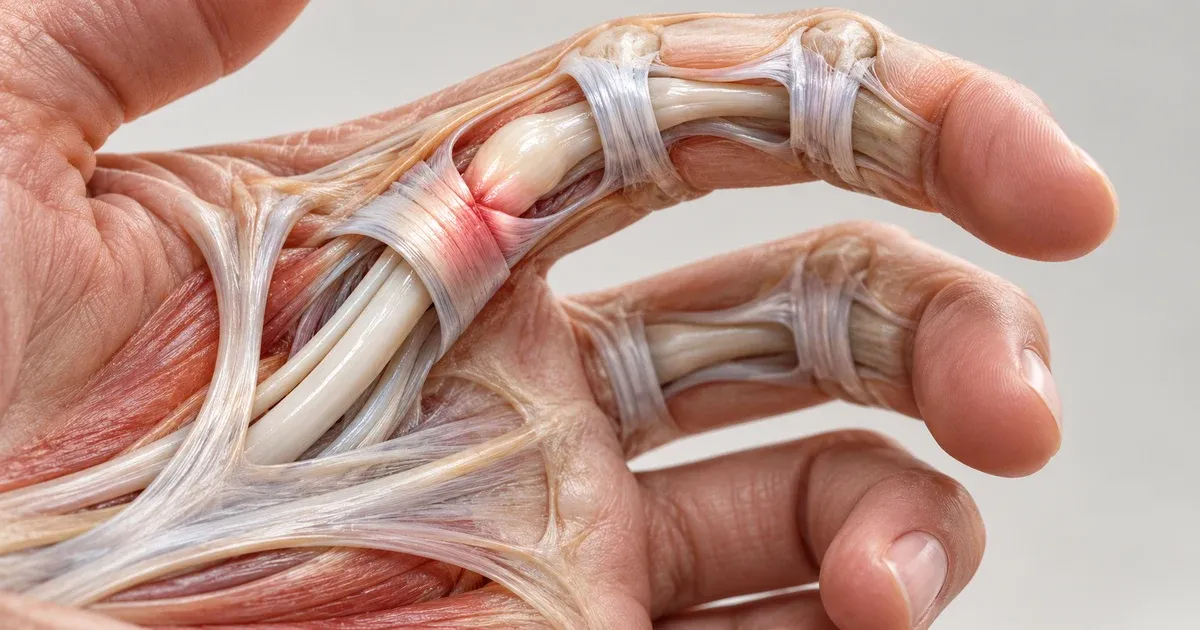
Tendons connect muscles in the forearm to the finger bones and help bend the fingers. Each flexor tendon moves through a series of bands called pulleys that hold it close to the bone. If the tendon or the surrounding sheath becomes irritated or thickened, it may not glide smoothly through a pulley near the base of the finger. The finger can then catch during bending or straightening. [1, 2]
Symptoms may include tenderness at the palm-side base of a finger, stiffness, clicking, or a finger that temporarily locks in a bent position. Some people feel a small tender lump near the base. Symptoms can be worse after periods of rest, such as in the morning. The thumb can be affected as well. One or more fingers may have symptoms, and the pattern varies. [1, 2]
What the symptoms do and do not tell you
Triggering that happens repeatedly with finger motion can fit this condition, but clicking alone does not confirm it. A jammed finger, arthritis, tendon injury, or another hand problem can also cause pain, stiffness, or reduced motion. A sudden injury followed by bruising, swelling, deformity, or inability to bend or straighten the finger needs assessment as an injury rather than an assumption of trigger finger.
Make a note of which finger is affected, whether it catches while bending or straightening, how often it happens, and whether you need the other hand to release it. Mention numbness, weakness, or a recent injury. Avoid repeatedly forcing a stuck finger straight; that can increase discomfort and does not identify the cause.
When to seek care
Arrange an assessment when catching or locking keeps returning, interferes with work or daily activities, becomes painful, or limits your ability to move the finger. A finger that stays locked or symptoms that are worsening also deserve prompt evaluation. Wiki Wiki Orthopedics evaluates hand and wrist conditions, including tendon and joint problems.
Seek urgent care after an injury if the finger is visibly deformed, has an open wound, becomes pale or blue, feels cold, or develops new numbness. Get emergency help for severe bleeding or a serious injury. Do not try to straighten a deformed finger yourself.
What an examination may involve
A clinician will ask how symptoms began and what movements cause catching. The exam may include watching the finger bend and straighten, checking for tenderness or a nodule at the palm-side base, and assessing motion, sensation, and circulation. In many cases the diagnosis can be made from the history and physical examination. Imaging is not always needed, but an X-ray may be considered when an injury, arthritis, or another bone or joint problem is possible. [1, 2]
Wiki Wiki Orthopedics provides orthopedic urgent care and on-site X-rays. Read about splinting and casting and X-rays and advanced imaging. Bring prior imaging or records if available, and describe how the finger problem affects the tasks you need to do.
Treatment depends on the symptoms
Some people improve with changes to activities that repeatedly aggravate the finger or with a splint recommended by a clinician. A splint may limit movement for a period, but it needs to fit appropriately and may not suit every problem. Do not continue using a support that increases pain, swelling, numbness, or color change. Ask a clinician what movements are safe while the cause is being evaluated. [1, 2]
If symptoms persist or interfere with function, a clinician may discuss other options, which can include an injection or a procedure to release the tight pulley. The choice depends on the examination, how long symptoms have been present, which finger is involved, and personal health factors. No treatment guarantees that symptoms will resolve, and not every case requires a procedure. [1, 2]
Ask what the recommended option is intended to improve, what limitations to expect, and when to follow up if catching continues. If the finger becomes stuck and cannot be moved, pain rapidly worsens, or new numbness or color change appears, seek prompt care rather than waiting for a routine visit.
Sources
- Trigger Finger, American Academy of Orthopaedic Surgeons, accessed 2026.
- Trigger finger, MedlinePlus, accessed 2026.
For non-emergency finger catching on Oahu, request an appointment or call (808) 439-6201.