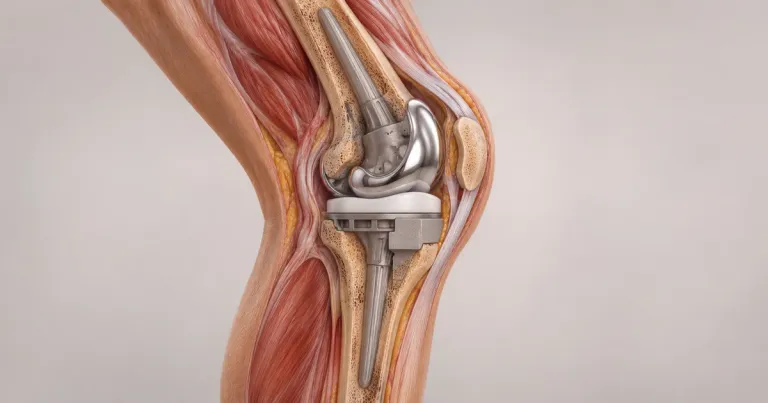
If knee arthritis is making walking, stairs, or everyday activities difficult, you may wonder whether replacing only part of the joint is possible. A partial knee replacement can be considered when arthritis is mainly confined to one compartment, but symptoms alone cannot determine whether it is appropriate. The pattern of joint damage, ligament stability, motion, overall health, and personal goals all matter. [1, 2]
What a partial knee replacement changes
The knee has three compartments: the medial (inner) side, the lateral (outer) side, and the patellofemoral area behind the kneecap. In a partial knee replacement, the damaged surfaces in one compartment are replaced with implant components while other portions of the joint are preserved. The operation is also called unicompartmental knee arthroplasty. A total knee replacement resurfaces more of the joint. Neither option is automatically better for everyone; the choice depends on the individual knee and the expected benefits and risks. [1]
Preserving more of the natural joint does not mean that a partial procedure is a minor or risk-free operation. It is still major surgery, and the unreplaced parts of the knee can develop symptoms or arthritis over time. Some people who have a partial replacement may later need another procedure, including conversion to a total knee replacement. A surgeon should explain these possibilities in the context of your findings rather than promise a particular result. [1, 2]
Who might be considered
A partial replacement is generally evaluated when osteoarthritis is advanced in one compartment and symptoms remain limiting despite nonsurgical care. The other compartments should be sufficiently preserved, and the knee's ligaments and movement need to be assessed. Significant stiffness, ligament injury, or arthritis in multiple compartments can make a partial replacement less suitable, though they do not by themselves determine which other treatment is best. [1]
Pain location can be a clue, but it is not a diagnosis. Inner-knee pain, for example, does not prove that arthritis is limited to the medial compartment. Symptoms may come from the meniscus, tendons, kneecap, hip, back, or more than one structure. An evaluation combines your history with an examination and imaging to understand where the damage is and whether it matches your symptoms.
Age, activity, health conditions, prior surgery, alignment, and expectations may also enter the discussion. Candidacy is individualized: an X-ray or a single symptom cannot establish it on its own. The purpose of the assessment is to compare reasonable options and clarify what remains uncertain.
What an evaluation may involve
A clinician may ask where the pain is located, how long it has been present, what activities make it worse, and how it affects walking, sleep, work, or recreation. The examination may assess tenderness, range of motion, alignment, stability, and other possible sources of pain. Bring a list of medicines and any prior knee imaging or treatment records that are available. Do not delay care for a new severe injury while gathering paperwork.
Weight-bearing X-rays are often used to look at the joint space and alignment. Additional views or other imaging may be considered if the initial pictures do not answer the clinical question. Imaging findings are interpreted alongside the examination; a picture alone does not decide which operation, if any, is right. [1, 2]
At Wiki Wiki Orthopedics, the knee care and surgical services pages describe the practice’s orthopedic evaluation and treatment scope. The practice lists partial knee arthroplasty among its surgical services and offers on-site X-rays and advanced imaging. Whether a particular person is a candidate requires an individual assessment.
Comparing partial replacement with other options
Before choosing surgery, discuss nonsurgical approaches that may help manage symptoms, such as activity adjustments, exercise or physical therapy, medication when medically appropriate, and other treatments recommended for your situation. A partial replacement may be one option if symptoms, examination, and imaging point to disease in a single compartment. A total replacement may be discussed when arthritis involves more of the knee. Other diagnoses can call for different care. [1, 2]
Useful questions include: Which compartment appears affected? Do my symptoms match the imaging? Are my ligaments stable, and how much motion do I have? What are the potential benefits, risks, and alternatives in my case? If surgery is recommended, ask what the procedure aims to address, what recovery and rehabilitation may involve, and what could lead to a later operation. The answers depend on individual findings, and no article can determine candidacy.
When to seek care promptly
Arrange an evaluation if knee pain is persistent, worsening, or limiting your usual activities. Seek prompt medical attention after a significant injury, if you cannot bear weight, or if the knee becomes markedly swollen, red, hot, or severely painful. Fever with a hot, swollen joint also needs urgent assessment. For a life-threatening emergency, call 911 or go to an emergency department.
Sources
- Unicompartmental (Partial) Knee Replacement, American Academy of Orthopaedic Surgeons, accessed 2026.
- Partial knee replacement, MedlinePlus, reviewed 2025.
- Surgical Management of Osteoarthritis of the Knee, American Academy of Orthopaedic Surgeons, 2022.
For persistent knee pain on Oahu, request an appointment or call (808) 439-6201.