When hand numbness keeps returning despite reasonable treatment, some people begin asking whether carpal tunnel release is the next step. The operation is intended to reduce pressure on the median nerve at the wrist, but there is more than one way to perform it. Ultrasound-guided release is an option worth discussing with a qualified surgeon, alongside conventional open and endoscopic techniques. The right choice depends on the diagnosis, nerve function, individual anatomy, and your priorities—not simply the size of an incision. [1, 2]
What does carpal tunnel release actually do?
The carpal tunnel lies on the palm side of the wrist. Several flexor tendons and the median nerve pass through a confined space bounded by wrist bones and the transverse carpal ligament. When pressure affects the median nerve, people may experience tingling or numbness in the thumb, index, middle, and thumb-side portion of the ring finger. Weakness and loss of dexterity can develop as nerve compression becomes more severe. [1, 2]
A release procedure divides the transverse carpal ligament to create more room for the nerve. It does not replace or repair the nerve itself, and it does not treat every cause of hand pain or numbness. Symptoms from a pinched nerve in the neck, an ulnar nerve problem, arthritis, or another condition require their own assessment. The hand and wrist conditions page explains several of these possible diagnoses.
How is ultrasound-guided release different?
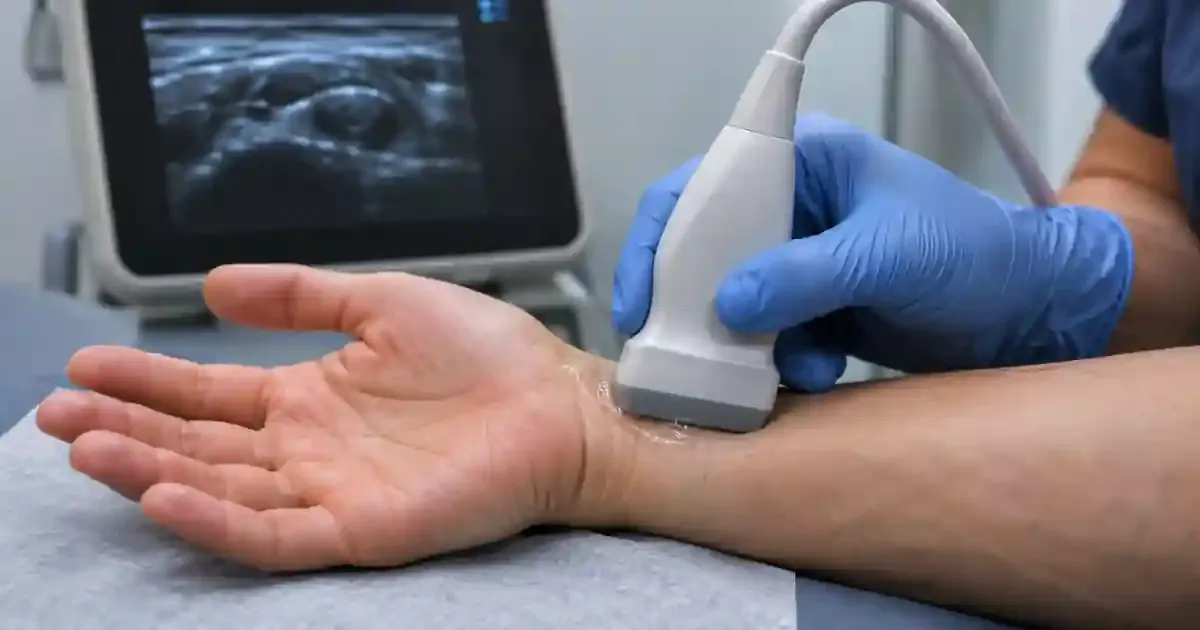
In a conventional open carpal tunnel release, the surgeon makes an incision in the palm or wrist and directly visualizes the structures involved in releasing the ligament. An endoscopic technique uses a camera and instruments through a smaller opening. Ultrasound-guided techniques instead use real-time ultrasound images to help identify the median nerve, nearby tendons, and other structures while the surgeon performs the ligament release through a small incision. [2, 3]
Ultrasound guidance is not the same as an ultrasound examination alone. An examination can help characterize anatomy; an ultrasound-guided release is an actual procedure that divides the ligament. The planned approach, device, entry point, anesthesia, and safeguards vary by technique and patient. You should ask the surgeon exactly what is being proposed, how complete release is confirmed, and what circumstances might require a different approach.
A smaller skin opening does not guarantee a shorter recovery or better nerve function. In a randomized comparison published in 2023, ultrasound-guided and mini-open approaches produced similar improvements in symptoms and function over the initial follow-up. A subsequent report of the same trial found similar symptom improvements at one year, while scar sensitivity differed between groups. The study was relatively small and industry-funded; it should inform a discussion, not replace individualized judgment. [3, 4]
Who should be evaluated before choosing a technique?
First establish that the median nerve at the wrist is the likely source of symptoms. A clinician may review which fingers are numb, the pattern of nighttime symptoms, hand strength, sensation, and how long symptoms have lasted. The diagnosis often rests on the history and examination. Electrical nerve testing or ultrasound may help in selected circumstances, but neither is automatically necessary for every patient. The AAOS guideline supports a structured clinical assessment rather than routine extra testing for all patients. [1]
Surgery may be discussed if symptoms remain troublesome despite nonsurgical treatment, numbness becomes persistent, or there is meaningful weakness or muscle wasting. Sometimes earlier surgical evaluation is appropriate when nerve function appears threatened. Mild or intermittent symptoms may instead be managed with a neutral-position nighttime splint, activity adjustments, or other individualized options. A corticosteroid injection may temporarily improve symptoms for some people, but current guideline evidence does not support it as a dependable long-term solution. [1, 2]
A prior wrist operation, unusual anatomy, significant scar tissue, a mass, a suspected different nerve disorder, or an uncertain diagnosis can affect which approach is appropriate. These factors do not automatically rule out a particular technique; they are reasons for careful planning. Availability of a specific release technique at a particular office should be confirmed directly rather than assumed.
What should you ask about the operation and recovery?
Before agreeing to surgery, ask what evidence supports the diagnosis and what improvement is realistic. Clarify whether the main goal is to reduce nighttime symptoms, address persistent numbness, or prevent further loss of nerve function. A nerve that has been compressed severely or for a long time may recover more slowly or incompletely, even if the ligament is successfully released. [2]
Discuss anesthesia, wound care, when to move the fingers, expected restrictions for lifting or gripping, driving, work duties, and follow-up. Recovery plans vary with the technique and the demands of the activity. Someone typing at a desk may have different needs from someone who uses vibrating tools or carries heavy equipment. Avoid assuming that a procedure described as minimally invasive means immediate unrestricted use.
All release methods carry risks, including bleeding, infection, injury to nerves or blood vessels, scar sensitivity, persistent or recurrent symptoms, and incomplete release. Ask how the surgeon approaches these risks, what warning signs to watch for after the procedure, and whom to contact if symptoms worsen. [2]
When is urgent or emergency care more appropriate?
Gradual hand tingling is usually a reason for an outpatient assessment, not an emergency department visit. However, seek prompt evaluation for rapidly worsening weakness, persistent loss of feeling, or a new problem after an injury. A cold, pale, severely painful or visibly deformed hand after trauma needs urgent emergency assessment.
Call 911 for sudden one-sided arm or facial weakness or numbness, trouble speaking, new confusion, or other possible stroke symptoms. Those signs should never be attributed to carpal tunnel syndrome without emergency assessment.
What happens at Wiki Wiki Orthopedics?
Wiki Wiki Orthopedics can evaluate non-emergency hand and wrist symptoms on Oahu and discuss whether conservative treatment, additional testing, or surgical consultation is appropriate. The practice's surgery information describes carpal tunnel release among its orthopedic services, but that page does not specify which release technique would be appropriate or available for an individual patient. If you are specifically interested in ultrasound-guided release, ask about that technique during scheduling and consultation.
Bring a brief timeline of symptoms, any prior splints or injections, relevant medical conditions, and any existing nerve-study results. Your next step should be based on a clear diagnosis and a discussion of benefits, limitations, and alternatives—not pressure to choose a particular procedure.
Sources
- Management of Carpal Tunnel Syndrome: Clinical Practice Guideline, American Academy of Orthopaedic Surgeons, 2024.
- Carpal tunnel release, MedlinePlus Medical Encyclopedia, updated 2025.
- Multicenter randomized trial of carpal tunnel release with ultrasound guidance versus mini-open technique, Expert Review of Medical Devices, 2023.
- Final 1-Year Results of the TUTOR Randomized Trial Comparing Carpal Tunnel Release with Ultrasound Guidance to Mini-open Technique, Plastic and Reconstructive Surgery Global Open, 2024.
For non-emergency hand symptoms on Oahu, request an appointment or call (808) 439-6201.